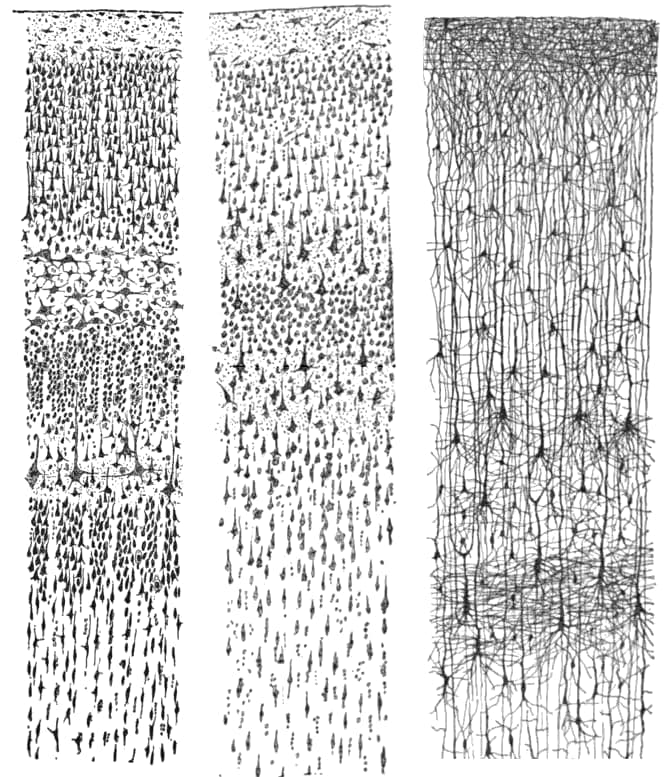
The parasympathetic case for slowness
Most discourse treats arousal as acceleration. The neuroscience suggests the opposite — that safety, attunement, and deliberate pacing unlock deeper states of pleasure.
Dr. Elena Vasquez
Neuroscience Editor
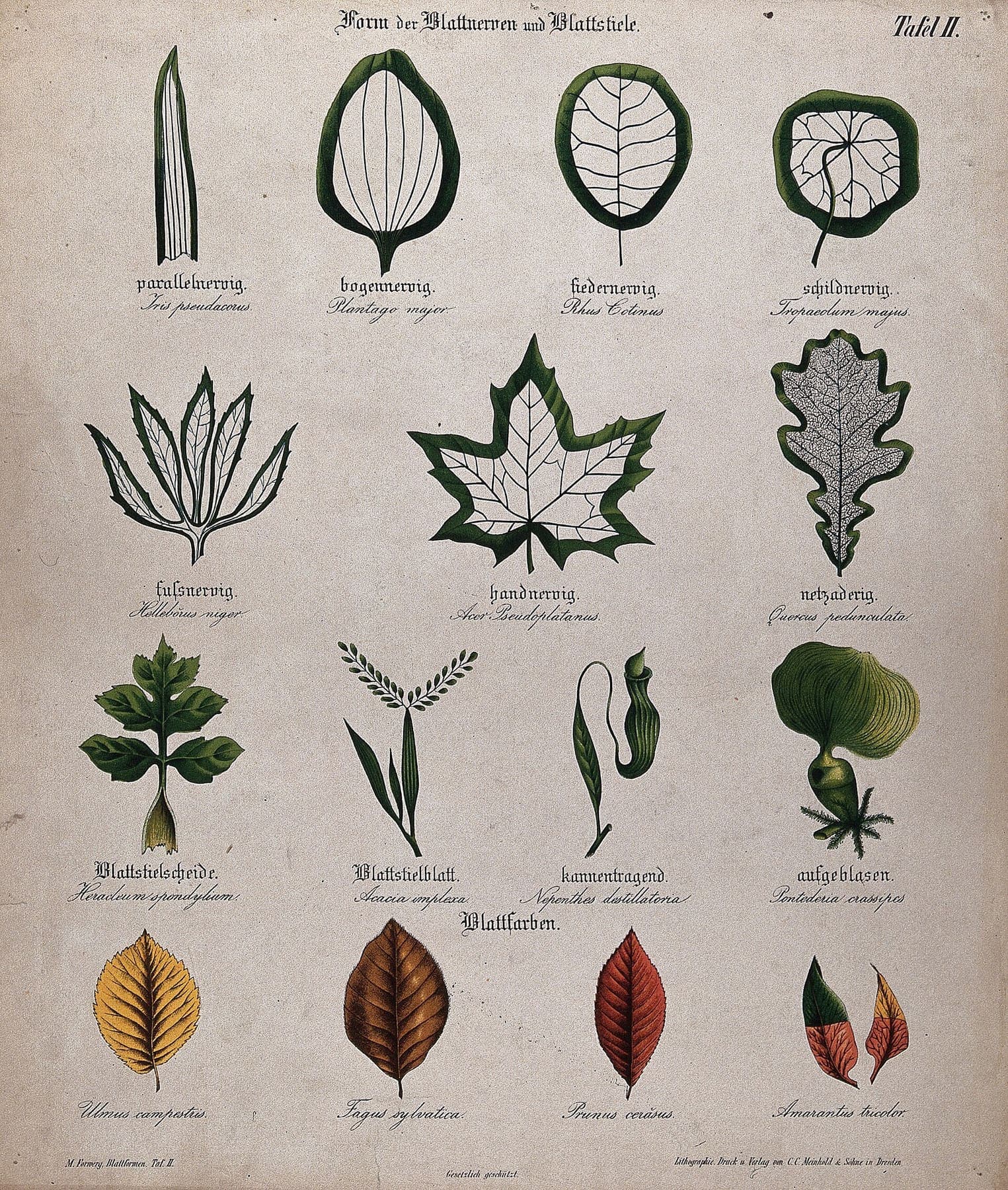
Plate I — Fifteen plant leaves with different types of venation
When the autonomic nervous system registers safety — through predictability, attunement, and explicit consent — the body opens to states of pleasure that rushed stimulation cannot access. This is not mysticism. It is measurable physiology.
The speed trap
Mainstream culture treats arousal as a linear ramp: faster stimulation, higher intensity, quicker climax. For experienced practitioners, this model fails immediately. The body is not a machine with a throttle. It is a negotiated system of excitation and inhibition[1], governed largely by the autonomic branch Porges called the ventral vagal complex[2].
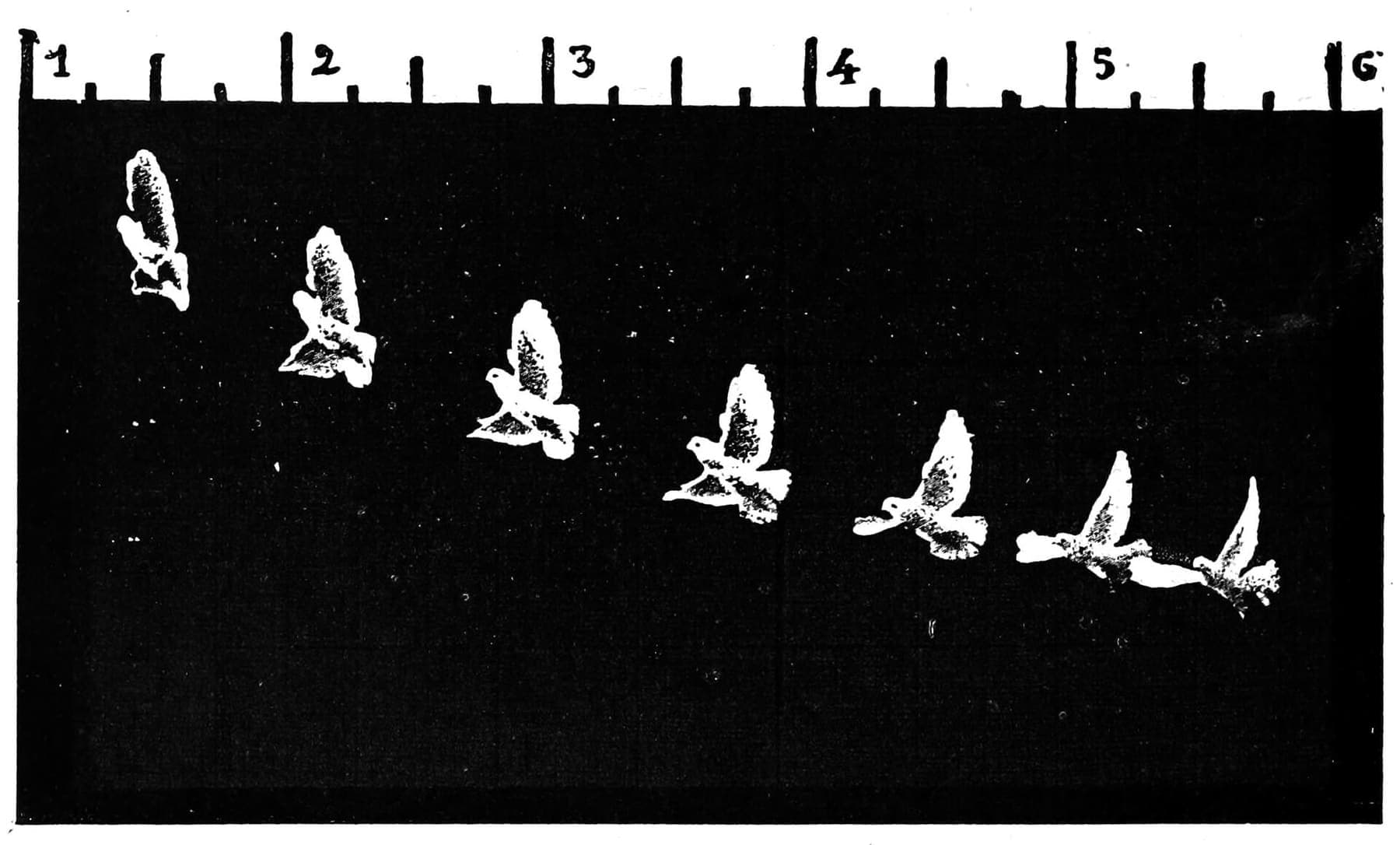
Marey, 1885: a pigeon photographed at fixed intervals against a scale. Before the body could be understood as a system of signals, it had to be recorded as one — sampled at intervals, against a measure.
When the sympathetic nervous system dominates — whether from performance pressure, ambiguous consent, or simple overstimulation — the prefrontal cortex loses bandwidth. Negotiation becomes harder. Sensation becomes noise. What looks like "high arousal" is often sympathetic flooding: intensity without depth.
What slowness actually does
Deliberate pacing activates parasympathetic tone. Heart rate variability increases. Interoceptive awareness — the ability to read one's own internal signals — improves. In fMRI studies of partnered intimacy, regions associated with self-referential processing and emotional regulation show increased coupling when subjects report feeling "safe enough to let go."
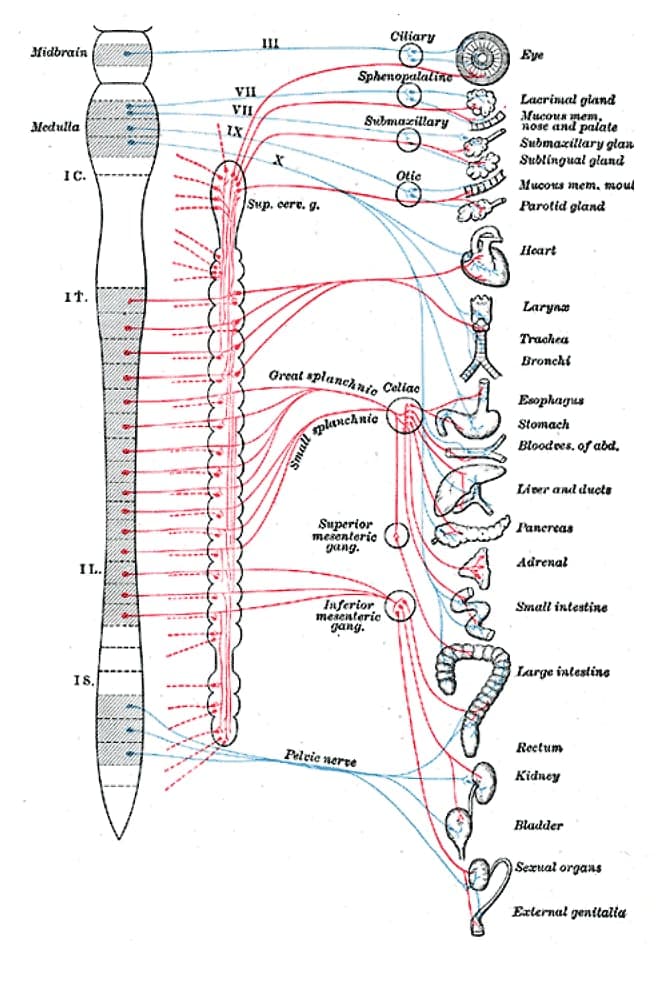
Two branches, one body. The sympathetic chain (left) and the parasympathetic outflow, including the vagus, as drawn for Gray's Anatomy. Slowness is a way of choosing which branch is in charge.
For kink practitioners, this maps directly onto scene design. Rope that takes forty minutes to apply is not foreplay padding. It is nervous system preparation. Impact play spaced with check-ins is not interruption. It is co-regulation.
Implications for scene architecture
Experienced tops already know that the best scenes often feel unhurried. The neuroscience gives us vocabulary:
- Predictability reduces amygdala activation, freeing cortical resources for sensation
- Attunement — reading micro-shifts in breath, muscle tone, vocal pitch — is interoceptive co-processing, not guesswork
- Explicit consent is not a legal checkbox; it is a precondition for parasympathetic engagement
What to do with this
If you already practice slow scenes, you are not being precious. You are working with physiology. If you teach, frame pacing as technique, not temperament. If you write negotiation scripts, build in transitions — not because play stops, but because the nervous system needs ramps, not cliffs.
NeuraKink will continue publishing research-backed frameworks for practitioners who want depth, not dumbed-down 101 content. This is the first.
Porges, S. W. (2011). The Polyvagal Theory: Neurophysiological Foundations of Emotions, Attachment, Communication, and Self-regulation.
W. W. Norton. The source of the 'ventral vagal complex' framing used throughout this piece.
Nagoski, E. (2015). Come As You Are: The Surprising New Science That Will Transform Your Sex Life.
Simon & Schuster. A general-audience account of the dual control model of sexual response (excitation and inhibition).
Komisaruk, B. R., Whipple, B., Crawford, A., Grimes, S., Liu, W.-C., Kalnin, A., & Mosier, K. (2004). Brain activation during vaginocervical self-stimulation and orgasm in women with complete spinal cord injury: fMRI evidence of mediation by the vagus nerves.
doi.org/10.1016/j.brainres.2004.07.029
Brain Research, 1024(1–2), 77–88. Further reading on vagal pathways in arousal.
- Dr. Elena Vasquez — Neuroscience Editor
- 12 minutes
- 3 listed
- Fifteen plant leaves with different types of venation — Unknown engraver, 19th century. Wellcome Collection, London. CC BY 4.0.
- Chronophotograph of a pigeon in flight, against a scale — Étienne-Jules Marey, 1885. Wikimedia Commons. Public domain.
- Diagram of the efferent sympathetic and parasympathetic nervous system — Henry Vandyke Carter, 1918. Wikimedia Commons. Public domain.
Continue the inquiry
Related investigations
The neurochemistry of trust in power exchange
Oxytocin, dopamine, and cortisol interact in ways that explain why structured power exchange can feel profoundly bonding — and why it can go wrong.
Consent as a continuous practice
The binary model — ask once, proceed — fails under scrutiny. For experienced practitioners, consent is an ongoing physiological and relational process.
Power exchange and the prefrontal cortex
Submission and dominance are not merely roles. They engage distinct cognitive networks — with implications for how we design scenes and debrief afterward.